Quasar 438B: What "Europe's Leading AI Model" Is Made Of


Quasar 438B is a pruned GLM-5.2 served via Amazon's cloud. Read what Multiverse built, what pruning cost, where the quantum is and four questions for sovereign-AI pitches.
On 2 September 2026, Multiverse Computing of San Sebastián launched Quasar 438B as "Europe's most intelligent AI model", citing a score of 43 on the Artificial Analysis Intelligence Index (version 4.1.1), 13 points ahead of Mistral Medium 3.5. Its press release called the launch "a significant step for European sovereign AI". The launch post and the press release named no base model. Multiverse's API documentation did: since 5 August, its changelog had said that Quasar's "capabilities are identical to GLM 5.2", the open-weights model Z.ai released in Beijing in June.
There is real engineering in Quasar, and a product worth taking seriously. There is also, in my view, a label that over-promises. Call it sovereignty-washing: the compression work Multiverse did is European, the base model is from Beijing, its API runs on Amazon, and no AI Act documentation has been published for Quasar itself.
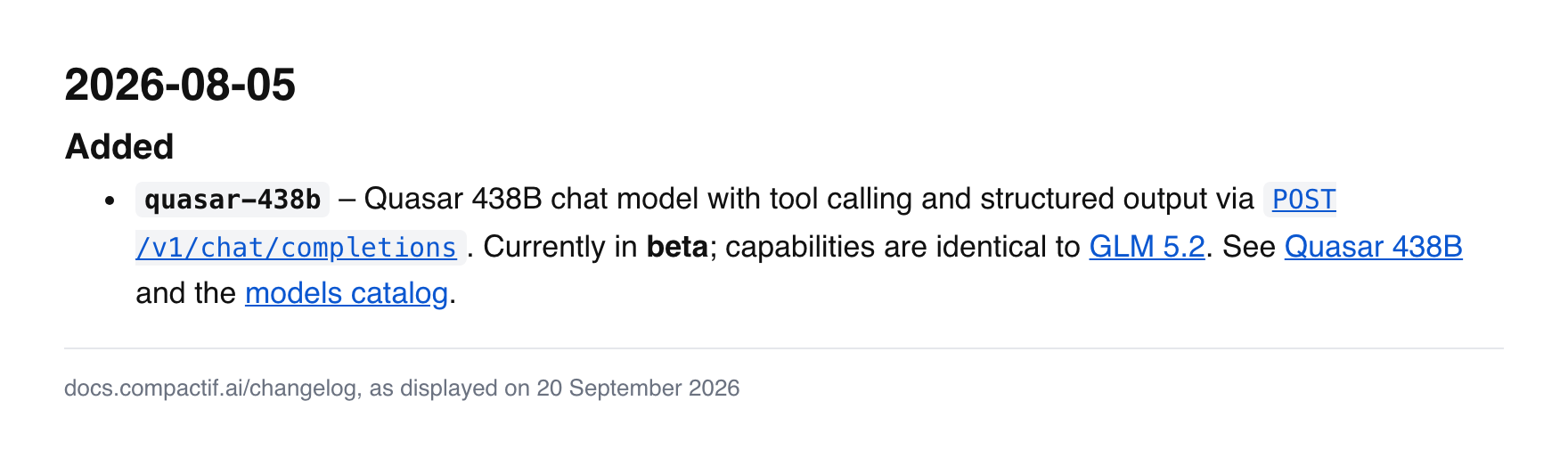
The launch reached three audiences at three speeds. Technical people (who read changelogs) knew within a day: a Spanish account on X quoted the entry on launch day, the top comment on the Hacker News thread quoted it too, and Multiverse confirmed the base model on X the next morning. Some of them wrote Quasar off as a compressed Chinese model. People who only read press releases still have not caught up. One widely shared post from the same afternoon read the launch as proof that "Multiverse topped the leaderboard without the capital structure US labs consider minimum for frontier work, which means every no from Brussels now requires better justification".
The third group are decision-makers who will be pitched "sovereign AI" and have better things to do than read changelogs or scroll on X. For them, I think four things separate a good product built on someone else's model from a label: the base model, who controls its versions, where it runs and who documents its legal obligations. Quasar is both a good product and a label, which makes it a useful case to discuss.
A Chinese base, compressed in San Sebastian
Multiverse started with an existing model, GLM-5.2, built by Z.ai in Beijing and released on 13 June 2026 under the MIT license, which lets anyone download, modify and sell it. Multiverse removed some of the model's internal processing blocks, trained what remained to recover performance and stored the numbers more compactly. The result needs less memory to run. Whether it is a better choice for applications depends on its cost and the control the customer receives.
Multiverse's technical note describes three operations. GLM-5.2 has 256 processing blocks, called experts, in every expert layer, and Multiverse cut that to 148. It then ran a "healing" pass "focused on recovering and sharpening agentic and coding behavior". Finally, it stored the result in two compact number formats and serves the less compact of the two. The training data for the healing pass, its size and the compute spent are not disclosed.
The Spanish press settled on clon chino ("Chinese clone") and the SEO blogs on "Europe's fastest model". I think both miss the key point. Cutting 108 experts out of every layer of a 753-billion-weight model and ending up with something that still writes decent code takes real engineering. There is no off-the-shelf recipe for that, and Multiverse did it within 11 weeks of the base model's release.
Multiverse's API combines its compressed models (Quasar, Carina 60B and a slimmed-down Whisper) with hosted originals from other developers (GLM, Nemotron, Qwen and Mistral Small). It prices them respectively: the unmodified GLM-5.2 and GLM-5.3 cost $1.10 per million input tokens and $3.50 per million output tokens, while Quasar costs $0.60 and $1.80. On Multiverse's price list, the Chinese original is the premium product and the European one is the value tier.
Multiverse's lead investor describes its technology as "the leading downstream LLM compression technology". I think downstream is the right word. I have spent years selling managed services: other vendors' components, our labor on top, one service under our name. Nobody cares whether the switches used in the service are Cisco or Juniper (and nobody needs to). But nobody sells a managed platform without naming the platform. In this case Quasar is the platform.
Quasar is also a closed-weights derivative of an open-weights model. GLM-5.2's weights are public, although, it says nothing about its training data. Quasar is API only. There is no download, and the license terms are unpublished. So a buyer who picks Quasar over GLM-5.2 for provenance reasons ends up with less transparency than the Chinese original offered.
The crucial concern I have is that marketing leaves out two things. The first is the sentence "built from GLM-5.2", which the company's own documentation had in effect been saying for a month. The second is what "European" actually covers. The launch used the word as if it described where the model's knowledge came from which is not true. What is European is the compression work and the company that did it.
Faster and cheaper, and lower on the index
A large language model is a stack of layers, and each layer performs a fixed set of calculations on the token passing through. In a mixture-of-experts model, part of each layer is a bank of interchangeable processing blocks (experts) and a small routing step that picks a few of them for each token. Despite the name, the experts are blocks of arithmetic that training has made useful for different kinds of input. GLM-5.2's routing step activates eight of its 256 experts per token, which is why a model with 753 billion weights does only about 40 billion weights' worth of arithmetic per token.
Expert pruning deletes the least useful experts. Published methods such as Cerebras's REAP do it in one shot and report quality "largely maintained". Multiverse's claimed refinement is to choose the survivors jointly per layer, on the grounds that experts overlap, and then to retrain what remains. That retraining is the healing pass.
This has two consequences. If the routing step still activates eight experts per token, as expert pruning normally leaves it (Multiverse does not say otherwise), the arithmetic per token barely changes. What shrinks is the stored size of the model, and with it the number of GPUs needed per copy. And because a model's knowledge is spread across its weights rather than filed in particular blocks, removing blocks degrades capabilities unevenly. Serving the model is more economical.
Which capabilities suffered is an empirical question, and Artificial Analysis answers at least part of it. On 7 September, five days after the launch, it replaced version 4.1.1 of its index with version 4.3, swapping in a harder terminal benchmark and a new business-workflow test. Scores from the two versions are not directly comparable, so the launch's 43 cannot be set against today's figures. On the new version (revision 4.3.2, as read on 20 September), Quasar scores 27. GLM-5.2, the model Quasar was derived from, scores 34. The sub-scores show where the finished model loses ground to its parent.
| Benchmark (Intelligence Index v4.3.2) | GLM-5.2 | Quasar 438B |
|---|---|---|
| Humanity's Last Exam (broad knowledge) | 41% | 19% |
| CritPt (physics reasoning) | 21% | 9% |
| GDP.pdf (document tasks) | 10% | 5% |
| AA-Omniscience (knowledge minus hallucination) | 4 | −3 |
| SciCode (scientific coding) | 51% | 48% |
| AutomationBench (business workflows) | 28% | 24% |
| AA-LCR (long-context reasoning) | 78% | 76% |
| Overall index | 34 | 27 |
Source: Artificial Analysis, Quasar vs GLM-5.2, as read on 20 September 2026. The index is revised frequently, so a live visit may show different figures.
Scores on the knowledge-heavy tests fell sharply. Coding (SciCode) and long-context reasoning barely moved, and business workflows (AutomationBench) lost four points. That broadly matches what Multiverse says the healing pass was aimed at, "agentic and coding behavior": the capabilities it chose to protect lost the least.
On speed the comparison shows Quasar at 175 tokens per second against 76 for GLM-5.2. It comes from some mix of the compact number format, the smaller memory footprint and Multiverse's own inference setup. The proportions in the mix cannot be measured from outside, so the number tells you as much about how Multiverse serves the model as about the model itself. Quasar is also, in Artificial Analysis's words, "very verbose": it produced 380 million output tokens during evaluation, against a median of 87 million for comparable models.
A compressed model is supposed to give something up. Quasar gave up seven index points against its parent, in exchange for speed and a lower price per token.
The quantum is in the vocabulary, not the model
Multiverse Computing was founded in 2019 as a quantum-algorithms company for finance. Its co-founder and chief scientist, Román Orús, is a tensor-network physicist. That explains the vocabulary, but it tells you not much about the product: Quasar runs on conventional GPUs, and nothing "quantum" happens when you use it.
The first claim is "quantum-inspired", which in Multiverse's usage means tensor networks: a way of writing one enormous array of numbers as a combination of smaller ones, developed in physics to simulate quantum systems on conventional computers and used to compress neural networks since 2015. When Reuters covered Multiverse's Series B, the company stated it openly: the method "combines ideas from quantum physics and machine learning in ways that mimic quantum systems but doesn't need a quantum computer".
The second claim, made for the 1.1 release on 15 September, is "quantum-generated data". Here there is real hardware. Multiverse ran part of a hybrid model on the 156-qubit IBM Heron processor that the Basque government inaugurated in October 2025, and on a classical simulator of that chip. Some of the output went into Quasar's healing set. Multiverse does not say what share of the healing data came from it, or whether it did anything a classical synthetic-data generator could not.
| Claim | What it is | Hardware | Evidence it helped |
|---|---|---|---|
| "Quantum-inspired" compression | Tensor networks; classical math from physics, used in ML since 2015 | Conventional computers; no quantum processor | Method is real; its use in Quasar is claimed but not described in enough detail to assess |
| "Quantum-generated data" (1.1) | A hybrid model's outputs, some share of the healing set | IBM Heron, 156 qubits, plus a simulator | Share undisclosed; no comparison with conventional data |
| Quantum at inference | None | Conventional GPUs | Not claimed |
Sources: Multiverse technical note, Quasar 1.1 note.
Eleven weeks, and already behind
Multiverse took 11 weeks from base-model release to launch. By launch day, Z.ai had already deprecated GLM-5.2. GLM-5.3 was on Multiverse's price list, and GLM-5.3 Flash was out as well. On the current index version, Flash scores 42 to Quasar's 27. Thirteen days after launch, Multiverse shipped a rebuild of Quasar 438B that stayed on GLM-5.2. Holding MIT-licensed weights means Multiverse does not have to follow the upstream lab. It can keep developing the version it has, move to a newer base model or stop, on its own timetable.
The most straightforward way to visualize this is the calendar:
| Date | Event |
|---|---|
| 13 June 2026 | Z.ai releases GLM-5.2 under the MIT license |
| 15 July | GLM-5.2 goes live on Multiverse's API |
| 5 August | Quasar 438B enters beta on that API: "capabilities are identical to GLM 5.2" |
| 18 August | GLM-5.3 scores 45 on the index |
| 26 August | GLM-5.3 Flash scores 42 |
| 29 August | GLM-5.3 goes live on Multiverse's API |
| 2 September | Quasar 438B launches as "Europe's leading AI model" |
| 7 September | Index moves to v4.3: Quasar 27, GLM-5.2 34 |
| 15 September | Quasar 1.1, a full rebuild from GLM-5.2 |
Sources: CompactifAI changelog, Artificial Analysis changelog, Quasar 1.1 note.
For customers, a product built on someone else's model creates two dependencies. First, Quasar inherits capabilities and behavioral tendencies from GLM-5.2, including Z.ai's choices about what the model should answer or refuse. Second, the product's lifespan is at Multiverse's discretion.
Multiverse can change the first, and in one case deliberately did. In fact, it is their signature move: Its 1.1 note reports that refusals on politically sensitive prompts fell from 71 percent in GLM-5.2 to 64 percent in Quasar 1.0 and 41 percent in 1.1, through a steering vector (an adjustment to the model's calculations while it answers) rather than retraining. Multiverse has done this before, with a "de-censored" DeepSeek R1 in 2025 and "uncensored versions of GLM 5.1 and Qwen 3.6 27B" in July 2026. For a model sold for coding and agentic work, I would rank this tweak as, well, not very high.
The second dependency matters most where the model acts - agentic work and not chat. A developer using Quasar to write code will get different code from a changed model, and tests and review decide whether it is acceptable. An agent that files tickets or answers customers runs inside a harness (prompts, tool definitions, validation, approval steps) that was tuned and tested against one model's behavior. That harness can protect you only if you know the model has changed. Quasar 1.1 was such a change: it arrived under the same model name as 1.0, cut average output by 37.6 percent and lowered political refusals to 41 percent. The only public notice was a blog post. Nothing in the API or the model name indicated the switch, and a customer's logs show the same model name before and after. Multiverse publishes no version policy. Large US API providers publish dated model versions and deprecation notice periods, which I consider the minimum for a buyer who has to show which model made which decision.
For banks and insurers, this is a compliance question. For instance, DORA, the EU's operational-resilience regulation for the financial sector requires documented controls for ICT change management.
For the supplier, building on an MIT-licensed model is a better dependency than consuming an US frontier API: the supplier owns the weights, and the nobody can take them away. The customer of an API owns nothing.
Amazon at the front door, the EU only if you pin it
Nobody mentioned where Quasar runs. Multiverse's FAQ half-answers it: "Your requests stay inside Multiverse Computing's private network, hosted with our cloud service provider in EU and US data centers." The FAQ names an EU endpoint and a US endpoint (the addresses your software sends requests to), and says "the default global endpoint routes requests to whichever region offers fastest performance". According to the FAQ, prompts and completions are not retained and are never used for training. It does not name the provider, so I checked. The API hostname resolves to an AWS Global Accelerator address, and the IP ranges belong to Amazon. The response headers indicated eu-south-2, AWS's Spanish region in Aragón, for the default and EU endpoints; us-east-1, in Virginia, for the US endpoint. That locates the front door of the service, though not necessarily the GPUs doing the inference. For that, there is only the supplier's description: the FAQ's "EU and US data centers", and Multiverse's stating "on our AWS cluster" in a Hacker News post.
Like most European AI services, Quasar rents infrastructure from a hyperscaler, which puts a US company, subject to US law, into the service. The practical point is residency. Data stays in the EU only if your integration pins the EU endpoint, because the default picks whichever region is faster.
Z.ai has filed. Multiverse has published nothing.
For a bank or a public administration, the paperwork is the part of "sovereign" that counts. What they need from a European model is a provider that stands behind the documentation. The AI Act assigns the responsibility for documentation to the provider of a general-purpose model: technical documentation for the regulator, information for the companies that build on the model, a public summary of the training data and a copyright policy. Those duties have applied since August 2025, and the Commission's power to enforce them, including fines, began on 2 August 2026.
Is Multiverse the provider of Quasar in that sense? The Commission's guidelines give an indicative criterion for when a company that modifies someone else's model becomes the provider: training compute for the modification "greater than a third of the training compute of the original model". Multiverse does not disclose the compute it spent, so nobody outside knows. My understanding is that a pruning and healing pass is very unlikely to reach a third of the compute used to train a 753-billion-weight model. On the Commission's logic, Multiverse would then not be the provider of a new model, and the duties would stay with Z.ai as the provider of GLM-5.2. Because Z.ai released that model openly under MIT, and it (most likely) sits below the systemic-risk threshold, those duties are reduced to a training summary and a copyright policy. The guidelines give no one the job of documenting what was changed in San Sebastián.
This seems like a real governance gap to me. The most broadly known EU provider, Mistral, is much more pro-active: it signed the Commission's code of practice for general-purpose AI and publishes, model by model, documentation for downstream providers and a public summary of training content. Z.ai did not sign the code, but it has published a training-content summary on the Commission's template for the GLM-5 family, GLM-5.2 included. Multiverse was not on the signatory list as of its last update, on 31 July 2026. Its only word on the subject is a line in the 1.1 announcement: Quasar was "developed in line with EU regulatory requirements, including the transparency expectations of the EU AI Act". The code is voluntary. Still, on the public record, the only AI Act documentation for this model comes from Z.ai.
Four questions for any sovereign-AI pitch
So what should a buyer do with a "sovereign AI" pitch? The word "European" does four separate jobs in it, and each can be turned into a question with a checkable answer (which is how I have argued a buyer should read BSI's C3A catalog too: as a filter). Here are the four questions, answered for Quasar:
- What is the base model, and do you receive its weights? GLM-5.2 from Z.ai, under the MIT license. You receive an endpoint.
- What does the supplier support or retire, and at whose pace? Quasar 1.1 replaced 1.0 under the same name 13 days after launch, with no changelog entry. No version policy is published.
- Where does the model run, and under whose law? Behind an Amazon front door, with EU and US processing as described by the supplier. By default, the region is chosen by performance.
- Who documents the legal obligations for the model underneath? Multiverse does not. On the EU Commission's indicative criterion it is probably not the provider of a new model, and Z.ai's duties for GLM-5.2 are reduced by the open-source exemption.
Quasar is the second "sovereign" model this year built on someone else's weights. In July, a German one turned out to be built on Nvidia's Nemotron. In September, Quasar arrived on GLM-5.2, from a company the Spanish state has backed through its SETT fund with €59.2 million in 2025 and €107 million in June 2026. Two cases are a small sample, but for me this is an indication where we stand: On the current index version, Europe's highest score, Quasar's 27, belongs to a European compression of a Chinese model. The best-scoring model from Europe's leading model builder, Mistral Medium 3.5, scores 14, about half Quasar's score at a third of its size. For now, Europe's AI capability peaks at compressing and retraining someone else's open weights.
For Quasar, I would appreciate a more realistic label: compressed from GLM-5.2, served through Amazon's infrastructure and processed in EU or US regions, upgraded and retired on Multiverse's timetable. Multiverse could have written that at launch and lost nothing but one word: sovereign.
If you are being shown a European model this quarter and would rather argue about the four questions I would like to hear from you. The fastest ways to reach me are X, email and LinkedIn.
Thinking out loud, by email
Occasional notes on technology, Europe, and whatever else has my attention. No spam — unsubscribe anytime.






Member discussion