Who Actually Owns EUV?

Who owns EUV technology? The invention was American, the title is Dutch, the foundational patents expired, and export law does the controlling.
Under every news story about ASML, someone in the comments explains who owns EUV technology, and why that means Washington is in charge. On June 19, 2026, hours after news broke that the US Commerce Secretary had personally questioned ASML's CEO about a rumored EUV machine in China, a reply on X put it plainly: "Mostly, ASML uses EUV patents from the US DOE." Two weeks later, in another thread, the patents were "held by Intel and Micron." On Hacker News the same explanation has surfaced in at least four separate threads over the years, always stated as settled fact: ASML licenses its core technology from the US government, which therefore decides where the machines go.
This claim bothered me enough to spend some time to verify it. TL;DR The claim is wrong. Yet it is an interesting introduction to understanding how power actually works in the semiconductor industry.
The confusion comes from treating "who owns EUV technology?" as one question. It's actually four questions: Who invented the technology? Who holds legal title today? What actually protects the monopoly? And who decides where the machines go? The answers: an American research program, a Dutch company, twenty-five years of unwritten knowledge rather than the patents everyone argues about (those quietly expired, and nobody noticed), and export law. This post walks through all four.
Invented in America
The machine that only ASML can build descends from a research program organized by Intel and staffed by American nuclear-weapons laboratories. In 1997, Intel, Motorola and AMD formed a consortium called EUV LLC. Its goal was to industrialize extreme-ultraviolet lithography, which uses 13.5-nanometer light to print chip features finer than conventional deep-ultraviolet machines.
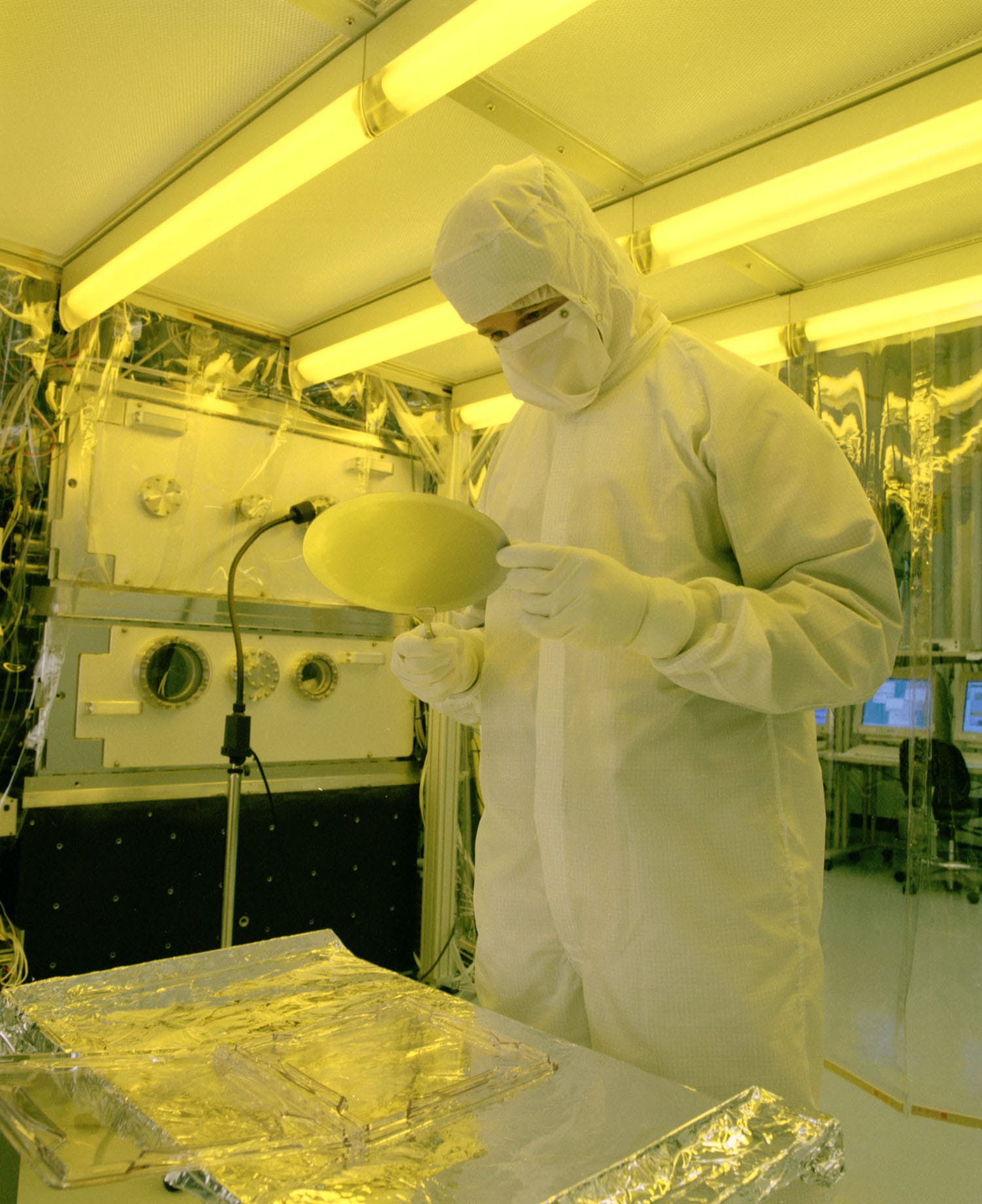
The physics came from three Department of Energy labs working together under a Cooperative Research and Development Agreement: Lawrence Livermore, Sandia and Lawrence Berkeley. The labs had spent the Cold War modeling plasmas and polishing optics for other purposes; as defense budgets shrank in the 1990s, lithography gave those capabilities a commercial mission. The consortium paid for essentially the entire program, roughly $250 million, and in exchange received the rights to the intellectual property it generated, a portfolio of some 150 patents. The government kept a royalty-free license to use the technology for defense purposes. The program's proof can be visited at Sandia: the Engineering Test Stand, the first full-scale EUV lithography prototype.
ASML played no part in any of this. It joined in 1999, as a licensee, after negotiating directly with Ernest Moniz, then Under Secretary of Energy. EE Times reported the admission conditions at the time: if EUV proved viable, ASML would build a US factory, establish an American R&D center, supply 100 percent of its US sales from that factory, and source 55 percent of the components in those machines from American suppliers. Congress had already blocked Nikon and Canon from obtaining the same license; no Japanese company should profit from American tax dollars. A Dutch ally was acceptable.
ASML met none of the conditions. No public record shows the factory commitment or the content requirements ever enforced, audited, or formally waived; ASML's EUV production stayed in Veldhoven, and the paper trail simply goes quiet. Marc Hijink, the NRC journalist whose 2024 book "Focus: The ASML Way" is the closest thing to an inside history of the company, goes even further: ASML "would never meet these conditions, nor did it ever intend to." He quotes Martin van den Brink, ASML's technology chief for four decades, on the negotiation: "My story to Moniz was quite simple. EUV meant a huge risk for ASML and that is why we would only accept this deal on our terms."
What the license actually bought mattered more than what it promised. Membership in EUV LLC meant participation in a running research program, with access to the labs, the researchers and the test stand, organized explicitly, in the words of SPIE's historical account, to reduce risk in "transferring the technology to industry for commercialization." Trade press at the time described ASML and its American rival Silicon Valley Group (SVG) "implementing the technology developed by the EUV consortium into process tools." The license was a ticket into a collaboration. The patents were the smallest part of what it conferred.
Moved to Veldhoven, with Washington's approval
The United States reviewed and approved every step that concentrated EUV in one Dutch town. The clearest case is Silicon Valley Group, the last American lithography manufacturer, which had held its own EUV LLC license since late 1997, before ASML got one. In October 2000, ASML announced it would buy SVG for $1.6 billion in stock, a deal pushed along by Intel CEO Craig Barrett, who ran about 200 SVG machines and needed the supplier kept alive. Because SVG owned Tinsley Laboratories, which polished optics for military satellites, and because SVG held EUV rights, the acquisition went through a formal CFIUS national-security review, including a meeting at the Pentagon and a 45-day investigation that reached the President's desk. ASML divested Tinsley, settled the "national security and defense issues regarding SVG's technology," and closed the deal in May 2001. Hijink's verdict on that moment is worth quoting: "When the US granted ASML permission to acquire its American competitor SVG in 2001, the monopoly on EUV technology fell into Dutch hands."
The history buried in that transaction deserves a sentence. The Wilton, Connecticut site ASML still operates came with SVG and descends from PerkinElmer, the firm the Department of Defense tasked in the late 1960s with building lithography machines for military chips, and which later ground the Hubble Space Telescope's famously flawed mirror. The United States had a national-champion lithography lineage of its own. It reviewed the sale of the last remnant, and signed.
The pattern repeated whenever a bottleneck appeared. In 2013, ASML bought Cymer of San Diego for €1.95 billion, the only company able to build the EUV light source, a device that fires lasers at 30-micron droplets of molten tin, 50,000 per second, to create plasma that emits the right wavelength. In 2016, ASML paid €1 billion for 24.9 percent of Carl Zeiss SMT, its sole optics supplier, to co-finance the next generation of mirrors. In 2020, it added Berliner Glas, a key supplier for the newest mirror systems. Van den Brink described the company's structure clearly: "We don't make anything here." Roughly 700 suppliers provide about 80 percent of each machine's value; ASML integrates. When one of those suppliers proves irreplaceable, ASML has tended to end up owning it, each time with the blessing of the country whose company it bought.
The original patents are expired
Let's return to the internet's favorite claim. The US government does retain rights in the foundational EUV patents: under the standard terms of DOE research agreements, a nonexclusive, paid-up license to practice the inventions for government purposes, plus march-in rights. CSET's history of the program states it in plain English: the DOE kept a royalty-free right to use EUV technologies for defense applications. That is the substance of "the US government owns ASML's technology." A defense-use license does not constitute ownership, and it confers no authority over whom ASML sells to.
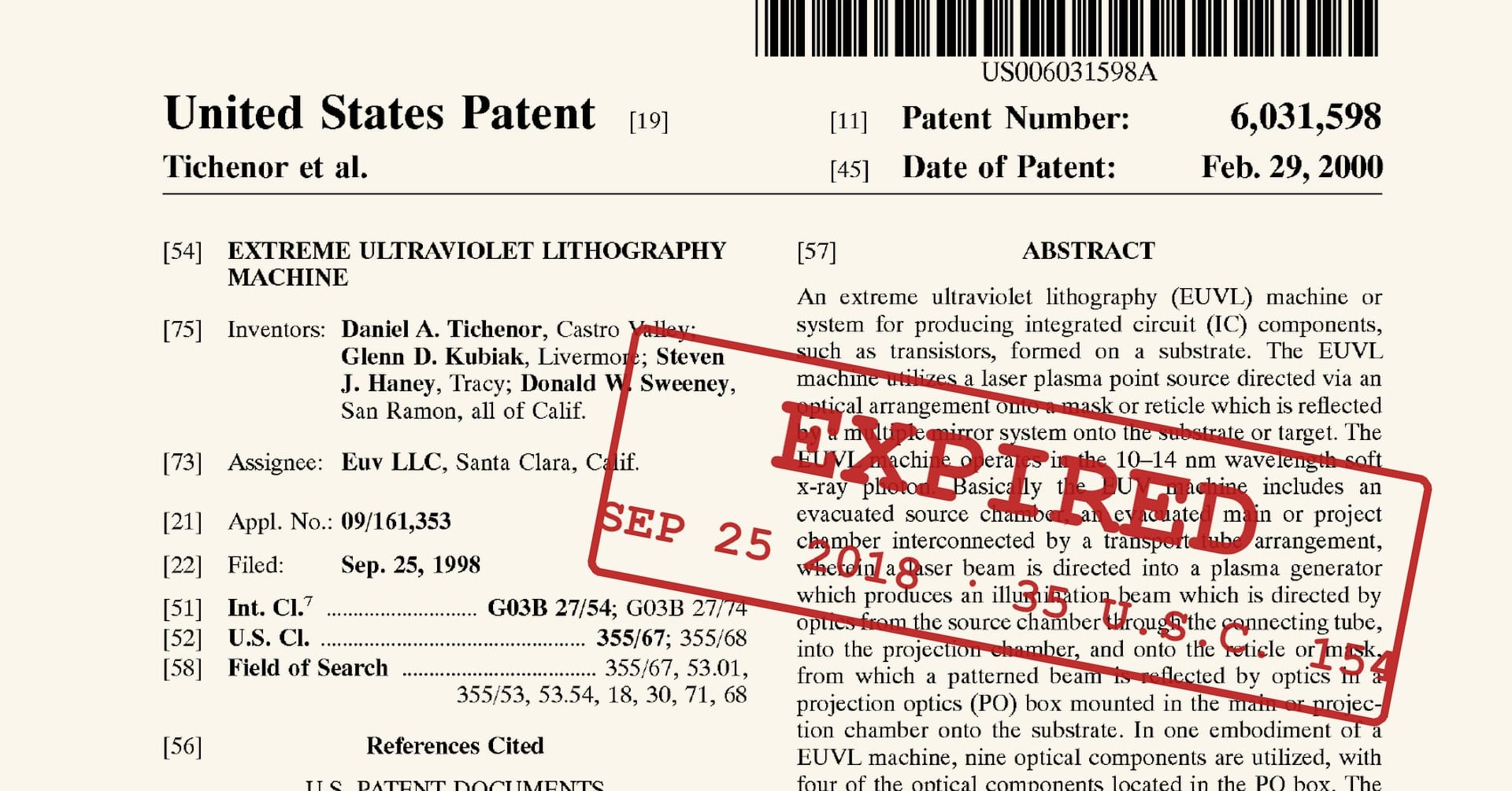
Title to the foundational patents sat with the consortium and with the labs' operating contractors, and you can check this patent by patent. US6031598A, "Extreme ultraviolet lithography machine," a Sandia-originated system patent filed in 1998, lists EUV LLC as its original assignee, carries the standard government-interest clause, and sits today with Sandia's operating contractor. On the commercial side, the trail runs opposite to what the internet often suggests. US8785892B2 covers the laser-produced-plasma light source, the most American part of the machine: filed by Cymer in San Diego and reassigned after the acquisition, its current assignee is ASML Netherlands B.V. Even the American paper flows to the Dutch parent.
And here is the part I have not seen written anywhere. Patents expire twenty years after filing, and the EUV LLC filings date from 1997 to 2003. The foundational patents, the ones the commenters often argue about, are expired. US6031598A is marked "Expired - Lifetime" in the public record; it lapsed on September 25, 2018. By around 2023 the rest of the cohort had followed. The patents at the center of the most-repeated claim about ASML ceased to exist between 2018 and 2023.
The foundational EUV patents expired between roughly 2018 and 2023, and nothing changed. That is the cleanest evidence available for what actually protects this monopoly: twenty-five years of accumulated manufacturing knowledge and a supply chain without substitutes, not the paper.
Nothing changed because the patents were never the issue. What separates a well-funded competitor from a working EUV machine is knowledge that never appeared in any patent filing. ASML burned €10 million a week on EUV development for years before the technology produced revenue. The nozzle of the tin-droplet generator inside every light source is hand-wound and soldered by two specific technicians in San Diego, work the company has concluded cannot be automated. Training one field-service engineer takes two and a half years. The mirrors come only from Zeiss in Oberkochen; the drive lasers only from Trumpf. And the patents that do matter today are ASML's own: an active estate of more than 38,000 assets across 32 jurisdictions, dating from ASML's commercial era rather than the laboratory years, with protection running deep into the 2030s. The company that entered the American program as a junior licensee now owns the practice.
What does this mean for China?
The expiration of the old patents unlocked nothing for China, because they never locked China out. Patents are territorial: a US patent excludes activity in the United States and says nothing about what happens in Shanghai. For the EUV LLC portfolio to have bound China, someone would have had to file Chinese counterparts, and there is no evidence anyone ever did. The content was public all along regardless, because patent filings publish; a Chinese engineer could legally read every EUV LLC patent in 2003. When Reuters investigated China's EUV program in December 2025, the barriers its reporting identified were export controls and licensing. Patents appear nowhere.
What actually constrains China shows up in the gap between two technologies. Where the technique has diffused and the tools are already on Chinese factory floors, China executes impressively. SemiAnalysis put Huawei's newest flagship chip under an electron microscope in July 2026 and measured what SMIC's best process can do running entirely on older deep-ultraviolet machines: wiring packed at a 32.5-nanometer pitch, tighter than the cells Intel uses on its newest EUV-built node, at a transistor density slightly above the TSMC EUV node in the comparison. The cost is severe: quadruple patterning, more masks, more process steps, worse yields, and finished chips that perform like Western flagships from three years ago. SemiAnalysis's summary was that SMIC "matched the wrong axis," and their outlook compounds: every further node without EUV comes out slower, more expensive and less forgiving than the last.
China remains far away, and not for lack of legal permission. The strongest reporting describes one prototype EUV machine in a high-security Shenzhen lab, linked to Huawei, which had not yet produced an operational chip. Chinese teams are pursuing at least three light-source architectures in parallel: a discharge-plasma design, a solid-state-laser variant of the approach Cymer industrialized, and an accelerator-based source at Tsinghua. Independent assessments converge on roughly a decade before China fields production-grade EUV. China's researchers are filing new EUV patents of their own, eight light-source filings in eighteen months from a team led by ASML's former head of source technology. Nobody is mining the expired American portfolio, because the valuable knowledge was never in it.
How Washington actually reaches ASML
The control mechanism is export law, backed by alliance management and anchored in one American component. The legal foundation is almost boring: EUV machines sit on the dual-use list of the Wassenaar Arrangement, the 42-country export-control regime, so every shipment needs a national export license, and the licensing authority is Dutch. Peter Wennink, ASML's CEO until 2024, described the arrangement: "We can ship to China because we get an export license from the Dutch government. So if there's any pressure, it'll be between governments."
The pressure came. In 2018 and 2019, the US ran a sustained diplomatic campaign, up to and including a White House briefing for the Dutch prime minister's circle, to stop a single EUV machine from reaching a Chinese customer; the Dutch government let the export license lapse. Washington needed no official statute. To this day, not one EUV machine or EUV-specific component has ever shipped to China.
For the older immersion-DUV machines, the mechanism became legal rather than diplomatic. In October 2023, the US Commerce Department created something genuinely novel: a zero percent de minimis rule for advanced lithography. Ordinarily, a foreign-made product falls under US export jurisdiction only when more than 25 percent of its value is US-controlled content. For machines in ASML's class, the threshold is now zero: any American content at all, and the entire Dutch-built machine needs US permission to ship. Every advanced ASML machine contains American content, because the light source comes from Cymer in San Diego, which ASML bought in 2013. Even sophisticated observers usually credit a different instrument here: the foreign direct product rule, which extends US jurisdiction to products made abroad using American tools and software, and which is how Washington stopped TSMC from making Huawei's chips. For ASML's own machines the hook is different. The de minimis rule attaches to what sits inside the machine, not to what the machine makes or was made with, and the distinction shows how deliberately Washington engineered the leash around that one Californian subsystem.
The situation has tightened ever since. October 2022 brought the broad US rules on advanced chipmaking. In January 2024, the Dutch government revoked already-granted licenses for top-tier DUV machines before they could ship. In September 2024, licensing extended to the next tier down. In April 2026, a bipartisan US bill proposed extending controls to servicing and maintenance of machines already installed in China. The commercial effect is measurable: from nearly half of ASML's system sales at the stockpiling peak of 2023 and 2024, China fell to 16 percent of revenue in the first half of 2026.
Can the US, then, dictate where ASML sells? As a veto, in practice, yes. Washington has subtracted China from ASML's leading-edge market three times with three different instruments: 1.) diplomacy for EUV in 2019, 2.) the de minimis rule for top-tier DUV in 2023, and 3.) allied licensing for the tier below in 2024. What it cannot do is compel a sale, set a price, or conjure up a customer, and its veto works only while the Netherlands, Japan and Germany keep agreeing to hold the same line. The US' control is real.
So, who actually owns EUV?
Dependency in this industry nests. America's own leading edge depends on Veldhoven: when TSMC's Arizona fab received its first ASML machine in December 2022, the ceremony took place under a giant "Made in America" banner, draped over a Dutch machine with German optics and a Californian light source. ASML - in turn - cannot move off Zeiss: a German foundation owns the optics maker and rebuffed the idea of a takeover when ASML floated it; a 24.9 percent stake was as far as it went. The light source depends on San Diego, where the same US content that anchors Washington's jurisdiction is also a production line ASML has, as far as the public record shows, never duplicated anywhere.
The answers to who owns EUV technology do not add up to an owner. The invention was American, and the program that produced it dissolved two decades ago. The title is Dutch, and the part of it that constitutes the leading edge is ASML's own recent work, not the foundational physics. The protection is knowledge that lives in specific buildings and specific hands in many countries. The control is a set of export rules that function only while four governments keep choosing the same side. Each participant holds a piece large enough to stop the others, and no piece large enough to stand alone.
Go deeper
I recommend reading Marc Hijink's "Focus: The ASML Way" (2024). It is the inside account, from the Moniz negotiation to the shop floor. The appendix contains brilliant pictures. Brian Potter's "How ASML Got EUV" at Construction Physics is the best free history of the technology transfer. And CSET's "Tracing the Emergence of Extreme Ultraviolet Lithography" documents the program-level detail, with footnotes, for readers who are interested in legal aspects.
Share your perspective ? The fastest ways to reach me are LinkedIn, X and email.
Thinking out loud, by email
Occasional notes on technology, Europe, and whatever else has my attention. No spam — unsubscribe anytime.





Member discussion